
100 Days Mission clock · Bundibugyo ebolavirus
Day 75
PHEIC declared 18 May 2026Day 100 falls 25 August 2026
The 100 Days Mission (100DM) clock for Bundibugyo ebolavirus (BDBV) started on 18 May 2026, following WHO’s declaration of the outbreak as a public health emergency of international concern (PHEIC). Africa CDC declared a Public Health Emergency of Continental Security (PHECS) the following day.
Leading up to Day 100 on 25 August, we continue to provide updates every 15 days (alternating between minor and major updates) on the status and progress of BDBV diagnostics, therapeutics and vaccines (DTVs) availability and highlight immediate priority actions to ensure products can be rapidly evaluated, manufactured, deployed, and are equitably accessible by affected communities.
On Day 75, we provide our latest major update on the status of BDBV diagnostics, therapeutics and vaccines. This update also includes a deep dive on the ongoing therapeutics and vaccine trials and access pathways, and highlights the priority actions needed to ensure products can be rapidly evaluated, manufactured, and equitably accessed.
These updates are intended to support the work of partners and key initiatives and are developed in consultation with implementing partners of the 100DM. We are open to feedback on the accuracy of our data; please get in touch (info@ippsecretariat.org) if you have information to share.
The data used to inform this update has been collected through desk research using public information and direct updates from implementing partners of the 100DM.
- Rapid overview
- Diagnostics
- Therapeutics
- Vaccines
- Immediate priorities
- Deep dive: therapeutics
- Deep dive: vaccines
- Calls for proposals
Rapid overview: Status of DTVs
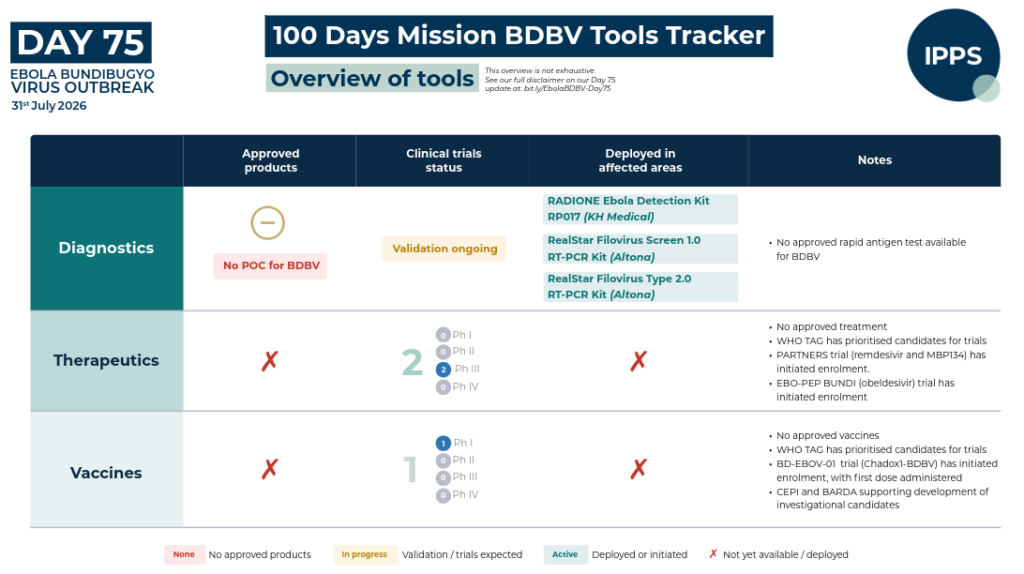
Diagnostics
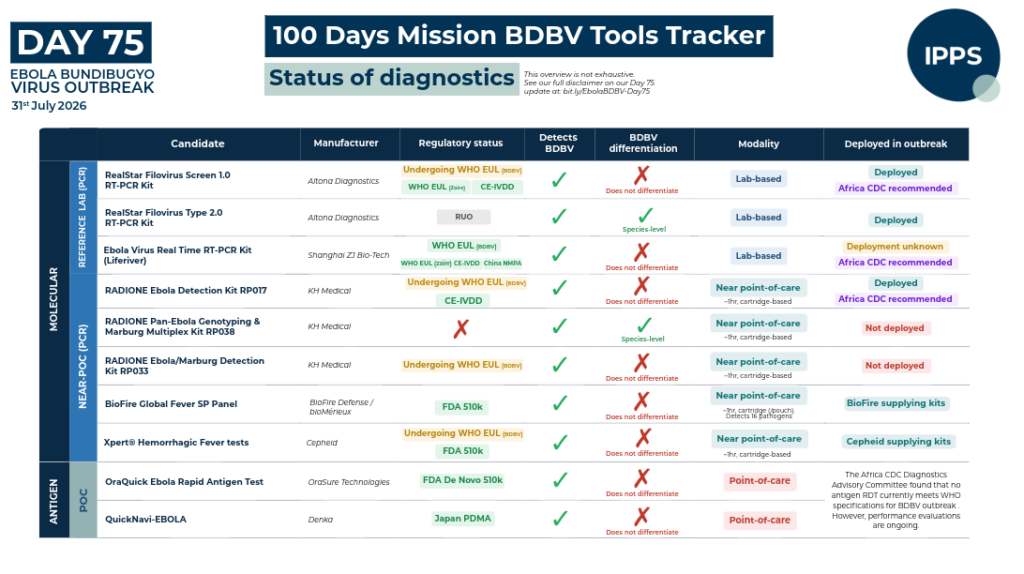
On Day 75, there are no approved point-of-care diagnostic tests specifically for Bundibugyo virus. The RADI Ebolavirus Detection Kit on the RADIONE platform (KH Medical Co., Ltd., Republic of Korea) remains the only near-POC molecular test operationally deployed. Reference laboratory diagnosis continues to depend primarily on the Altona RealStar® Filovirus kits, deployed both at fixed reference sites and via mobile laboratories supplementing testing capacity in the DRC.
On 2 July, the Ebola Virus Real Time RT-PCR Kit (Shanghai ZJ Bio-Tech, China) became the first product approved under the dedicated WHO Emergency Use Listing pathway for BDBV nucleic acid detection tests, with four further applications remaining under active review: the RADIONE Ebola/Marburg Detection Kit and RADIONE Ebola Detection Kit (KH Medical), the RealStar® Filovirus Screen RT-PCR Kit 1.0 (Altona Diagnostics), and the Xpert® Hemorrhagic Fever Panel (Cepheid).
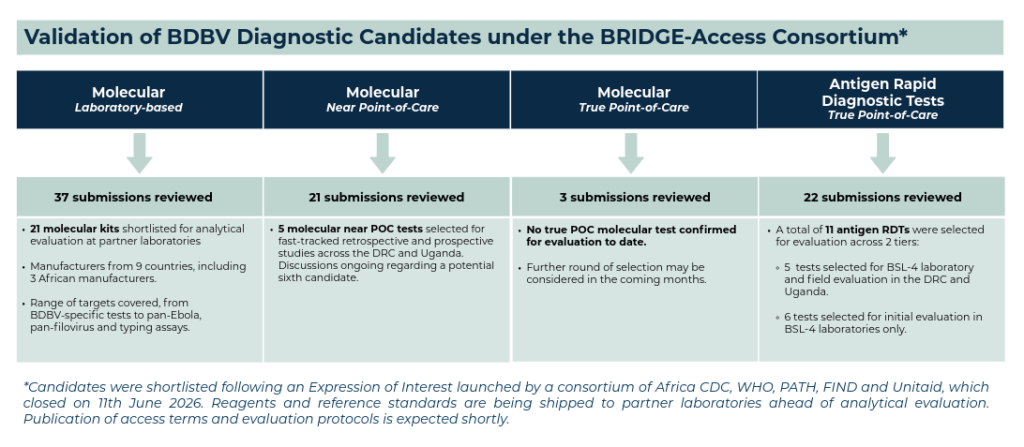
Validation of BDBV diagnostic candidates continues under the newly-named BRIDGE-Access consortium, with reagents and reference standards being shipped to partner laboratories ahead of analytical evaluation, and access terms agreements signed by the majority of shortlisted manufacturers; publication of both the access terms and the evaluation protocols is expected shortly.
On 9 July, WHO published revised interim guidance on diagnostic testing for Ebola and Marburg virus disease, updating recommendations on testing indications, specimen handling and preferred assay types in light of the current outbreak.
Additional efforts to strengthen the wider BDBV diagnostics pipeline continue in parallel, including but not limited to the true point-of-care gap: the Gates Foundation’s Grand Challenges initiative on Innovations in Decentralized Pan-Orthoebolavirus Diagnostics, is seeking field-ready solutions across biomarkers, specimen innovations, diagnostic products, surveillance, and quality assurance, with up to 12 awards available, while GHIT Fund has made its first award under an emergency funding framework it opened in June for Ebola RDT and point-of-care diagnostic development, supporting early-stage development of a portable diagnostic platform for BDBV. The RIGHT Foundation has also opened a request for proposals under its 2026 Product Development Award Targeted Call, supporting validation of existing diagnostic products with proof-of-concept or preliminary performance data for Ebola, including Bundibugyo virus, disease diagnostics in World Bank-defined low- and middle-income countries (LMICs).
Therapeutics
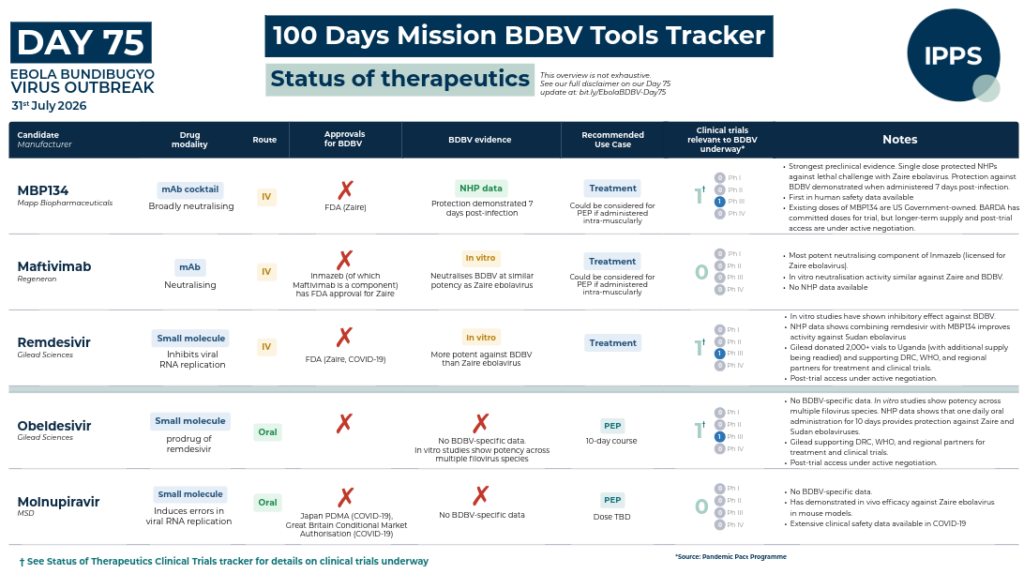
On Day 75, there are no approved therapeutics specifically for Bundibugyo virus disease. Two trials evaluating candidates prioritised by WHO’s Technical Advisory Group are now actively recruiting. The PARTNERS adaptive platform trial enrolled its first patient in DRC on 2 July – six weeks after the PHEIC declaration – targeting 700–1,000 participants; using a factorial design, it is assessing the monoclonal antibody MBP134 and the antiviral remdesivir, alone, in combination, or against supportive care alone. The EBO-PEP BUNDI trial opened recruitment in Ituri province on 14 July and enrolled its first participant in Bunia on 16 July – eight weeks after the PHEIC declaration – targeting enrolment of around 1,000 high-risk contacts; the trial is assessing the oral antiviral obeldesivir as post-exposure prophylaxis, with a parallel remdesivir sub-protocol available for children, pregnant and breastfeeding women, who are excluded from the obeldesivir arm pending paediatric formulation and safety data. Both trials were able to begin quickly by activating master protocols and regulatory infrastructure prepared in advance of this outbreak.
On access, funders, manufacturers, and government and clinical partners are in ongoing discussions on post-trial access for both treatment and PEP candidates, with manufacturing scale-up – including at-risk production ahead of efficacy data – identified as a key consideration. On 10 July, Unitaid announced an investment package of up to US$3.4 million to support preparation for rapid access to promising diagnostics and therapeutics, building on existing partnerships with Africa CDC, WHO, CHAI, PATH and The Aurum Institute. Coordination remains a challenge: unlike vaccines, where CEPI and Gavi provide dedicated end-to-end financing and coordination infrastructure, responsibility for therapeutics procurement and at-risk manufacturing financing remains fragmented across the ecosystem.
Vaccines
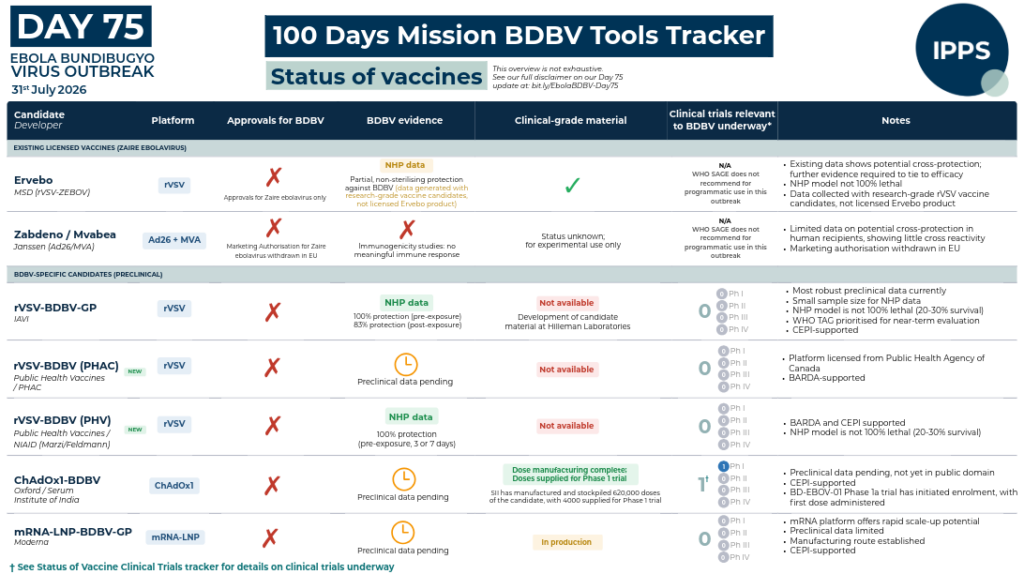
On Day 75, there are no approved vaccines for Bundibugyo virus disease. The Bundibugyo-specific vaccine pipeline has progressed from preclinical development into clinical trials. On 13 July, the University of Oxford launched BD-EBOV-01, the world’s first Phase Ia trial of a BDBV-specific vaccine, evaluating ChAdOx1-BDBV (Oxford University/Serum Institute of India) in 50 healthy adults. The first participants were enrolled on 20 July, just ten weeks after the PHEIC declaration, with the first vaccination administered on 24 July. The trial was made possible by manufacturing readiness built on the existing ChAdOx platform, which allowed the Serum Institute of India to manufacture doses at risk within two weeks (620,000 stockpiled, 4,000 for investigational use).
A second Phase 1 trial, of Moderna’s mRNA-LNP candidate, is expected to begin in August. CEPI is funding both programmes, alongside continued development of two rVSV-vectored candidates: rVSV-BDBV-GP (IAVI) and a second candidate developed by Public Health Vaccines based on NIAID research, one of two rVSV candidates BARDA has separately funded Public Health Vaccines to develop. On 12 June, the US Department of State committed $50 million to CEPI to accelerate BDBV medical countermeasures, with a stated goal of advancing at least two candidates through to emergency authorisation. On 20 July, CEPI published a funding appeal to sustain this programme over the next six to nine months, noting that a significant share of the near-term requirement remains unsecured. On 30 July, CEPI announced a manufacturing partnership with Hilleman Laboratories to produce rVSV-BDBV-GP clinical trial doses, with potential extension to other CEPI-funded rVSV candidates.
CEPI’s calls for proposals to advance additional early-stage BDBV candidates toward Phase 1 evaluation, and to generate supporting evidence including epidemiological modelling, closed in June, with selections underway; BARDA’s BundiVx Programme, seeking further VSV-platform candidates, closed in July, with outcomes awaited. A CEPI request for information on Phase 1 clinical trial capacity across Africa, published 15 July, found substantial existing capacity across 45 sites in 17 African countries, concentrated particularly in Kenya, South Africa and Uganda.
The only licensed Ebola vaccine, Ervebo®, is indicated for Zaire ebolavirus only, and WHO SAGE does not recommend its use outside controlled research settings for the current outbreak, in light of limited and inconclusive evidence on cross-protection against BDBV. Newly published data have reported cross-reactive BDBV antibodies in recipients of licensed Ebola vaccine regimens, though at much lower levels than against EBOV itself and of unknown protective value; while no trials of existing vaccines as a prime-boost regimen are currently planned, CEPI has indicated plans for serological evaluation of clinical samples from people previously vaccinated with EBOV and SUDV vaccines, including Ervebo, to assess this cross-reactivity further – evidence intended to inform decisions on how Ervebo could be used in the response, including as a potential arm in a future Phase 2/3 efficacy trial.
On access, work is underway to translate this rapid R&D progress into equitable deployment. Gavi has allocated $40 million from its First Response Fund to support BDBV vaccine access, and a joint UNICEF/Gavi Expression of Interest on licensure pathways and manufacturing scale-up closed on 10 July, with outcomes awaited. Vaccine partners are also developing a dedicated access roadmap, coordinated through the continental IMST, to identify critical access needs and link upstream R&D with downstream delivery across the ecosystem, work that will need to build in community trust from the outset, given that hesitancy and mistrust remain critical barriers to the response even where doses are available.
Immediate Priorities
Sustain and strengthen the public health and clinical response as the foundation of outbreak control
- Surveillance and contact tracing, infection prevention and control, safe and dignified burials, high-quality clinical care, and risk communication and community engagement (RCCE) remain the critical pillars of the response and must be strengthened and sustained across all affected areas. Community trust is essential at every stage – for clinical care uptake, safe burials, contact tracing, and clinical trial enrolment, as well as the eventual deployment of new medical countermeasures – and sustained engagement with local leaders, community figures, and health workers through culturally appropriate messaging must continue.
- Generating timely evidence on the social and behavioural dimensions of the outbreak must remain a priority to inform the response as it evolves. Outbreak-specific evidence on the actual impacts on affected communities, including gender-based violence, livelihoods, children’s education, and non-Ebola healthcare access warrants urgent attention from researchers and funders alike.
Scale diagnostic capacity and accelerate validation of new tools
- Expanding the number and throughput of testing sites and reducing sample transport times, while maintaining quality and biosafety standards, remain the most pressing operational priorities. Continuity of reagent supply, biosafety deficiencies, infrastructure limitations (power, connectivity, equipment), and shortages of trained laboratory technicians and sample collectors continue to constrain diagnostic capacity, and require targeted and sustained support from partners and funders.
- Manufacturers should continue to submit applications through WHO’s Emergency Use Listing (EUL) questionnaire for nucleic acid detection tests, and should be encouraged to pursue other regulatory pathways in parallel to performance evaluation efforts.
- Diagnostic validation efforts under the coordinated BRIDGE-Access process should be prioritised and financially supported as needed, with performance evaluation results completed as rapidly as possible to feed into EUL submissions and Africa CDC Diagnostics Advisory Committee recommendations. Development and validation of point-of-care solutions, including antigen-based rapid diagnostic tests, remains a critical priority for decentralised and community-level testing.
- Comprehensive mapping of laboratory capacity across affected and at-risk countries should continue, with results shared across partners in real time to identify gaps and maximise diagnostic accessibility. Partners engaged in diagnostic, WASH, PPE, and laboratory consumables procurement should participate in the central WHO-hosted procurement dashboard to avoid duplication and provide real-time visibility on supply chains.
Sustain and expand clinical trial recruitment and secure post-trial access commitments for therapeutics
- Both the PARTNERS adaptive platform trial and EBO-PEP BUNDI are now enrolling; sustaining this momentum requires continued attention to site readiness, cold chain, and logistics as recruitment expands to additional sites. Both trials have secured funding to begin, but additional financing will be needed to sustain recruitment and complete the studies.
- Children and pregnant and breastfeeding women currently rely on an intravenous remdesivir sub-protocol for PEP, given the absence of a paediatric obeldesivir formulation and unresolved safety questions in pregnancy. Given the severe outcomes filovirus disease has historically caused in both groups, generating the evidence needed to extend oral PEP options to them remains an urgent priority.
- Post-trial access commitments must be secured before trial results are available – including timely, equitable, and affordable access, in-country registration in DRC, Uganda, and neighbouring at-risk countries, and clarity on indemnification and compensation arrangements for trial participants and post-deployment use. Licensing arrangements will also need to ensure products can be used in both the current outbreak and future filovirus responses, at prices appropriate for the settings where they are needed. Financing for at-risk manufacturing – particularly where lead times are long and decisions must precede efficacy data – must be clarified and committed now.
- Social and behavioural science input should be strengthened alongside both trials as they proceed, spanning community engagement to build awareness of trial aims, real-time understanding of how the trials are being run and perceived by participants and communities, and how they are positioned within the broader social landscape of the response.
Sustain vaccine development momentum and define the full pathway to access
- A significant share of the near-term funding requirement to sustain the current vaccine R&D programme over the next six to nine months remains unsecured. Closing this gap is an immediate priority for maintaining the pace achieved so far.
- The first Phase Ia trial of a BDBV-specific vaccine, evaluating ChAdOx1-BDBV, is now underway, and continued support for its completion – including planned further studies in Uganda – will be important to generating the data needed for later-stage decisions. For the remaining candidates – including Moderna’s, expected to begin trials in August – immediate action must focus on completing preclinical requirements and producing clinical-grade material to enable trials to begin without delay.
- Future trial protocols should be designed to enable inclusion of children and pregnant women at the earliest appropriate stage, including through consideration of parallel or rapid Phase 2 studies in special populations, given the severe outcomes filovirus disease has historically caused in both groups.
- On access, the dedicated vaccine access roadmap being developed in support of the continental IMST needs to be finalised. Initial draft priorities are outlined further in the vaccines deep dive below, and include the need for country-level participation to ensure local considerations and product suitability are addressed, indemnification arrangements, and access approaches for displaced and refugee populations.
Separately, funders are assessing which candidates to support for Phase 3 studies and advance purchase commitments – Gavi has already allocated $40 million from its First Response Fund, and outcomes of a joint UNICEF/Gavi Expression of Interest on licensure pathways and manufacturing scale-up remain awaited.
Sustain regulatory momentum and operational coordination
- The collaboration between AMA, African regulatory authorities, WHO PQ, and EMA’s Emergency Task Force on regulatory pathways and EUL processes must be sustained to ensure medical countermeasures can be rapidly registered and deployed in affected and at-risk countries.
- Close coordination between affected governments, WHO, Africa CDC, regulators, procurers, and implementing partners remains essential to ensure financing and response tools can be deployed quickly and equitably.
Deep Dive
Therapeutics
At Day 75, the therapeutic response to Bundibugyo virus disease has entered a new operational phase. The two clinical trials central to the therapeutic research response – both evaluating candidates recommended by WHO’s Technical Advisory Group – are now actively recruiting and enrolling participants: the PARTNERS adaptive platform trial, which enrolled its first patient in DRC on 2 July 2026, and the EBO-PEP BUNDI trial, which enrolled its first participant in Bunia on 16 July. The simultaneous operation of a therapeutic trial and a post-exposure prophylaxis trial in an active outbreak – both designed to generate rapid, actionable evidence across the treatment and prevention spectrum – represents a significant achievement in the coordination of the research response.
Effective therapeutics and post-exposure prophylaxis (PEP) are essential components of any outbreak response – reducing mortality, protecting health workers, and helping break transmission chains. Communities are also more likely to seek care, cooperate with contact tracing, and participate in surveillance when meaningful treatment options are available. Several promising therapeutic candidates exist, and with no approved treatment or preventive intervention for BDBV, generating the evidence to establish whether those now in trial work is urgent. But generating evidence is only part of the challenge. The vaccine response has benefited from a decade of dedicated investment in development, financing, and procurement architecture that has no equivalent for therapeutics or diagnostics. Africa CDC and WHO have both highlighted this gap in therapeutics and diagnostics for outbreak response, and the need to build a strong R&D ecosystem and greater coordination of, and investment in end-to-end R&D of therapeutics and diagnostics, in a similar way to vaccines, including identifying financing mechanisms which reduce commercial uncertainty. Ensuring that effective interventions can reach patients and exposed contacts at scale – and equitably – will be as consequential as the trial results themselves.
Clinical readiness
Two trials are now running in parallel. PARTNERS, evaluating treatment for confirmed cases, and EBO-PEP BUNDI, evaluating post-exposure prophylaxis for high-risk contacts, both draw on master protocols and regulatory infrastructure built in advance of this outbreak, allowing both to begin recruiting within weeks of the PHEIC declaration rather than building trial systems from scratch.
PARTNERS adaptive platform trial
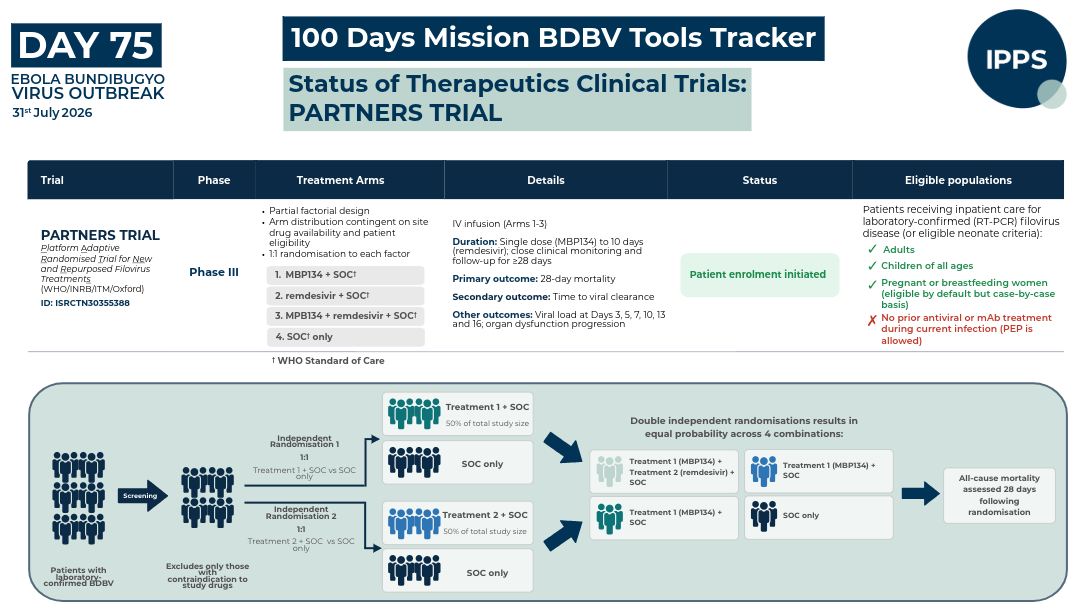
The PARTNERS trial – Platform Adaptive Randomised Trial for New and Repurposed Filovirus Treatments – is co-sponsored by WHO and the Ministry of Health of each participating country, and is an international collaboration between the Institut National de Recherche Biomédicale (INRB) in DRC, the Institute of Tropical Medicine (ITM) Antwerp, and the Pandemic Sciences Institute at the University of Oxford. Its core protocol was finalised at a WHO research readiness workshop in Kampala in February 2024, with the objective of enabling rapid activation when the next filovirus outbreak occurred. The value of this preparedness investment was demonstrated when the protocol was activated during the Rwanda Marburg virus outbreak in September 2024 and was enrolling within three weeks of the outbreak being declared. When the BDBV outbreak was declared a PHEIC in May 2026, DRC and Uganda country annexes and a Bundibugyo virus annex were developed and approved, enabling the trial to proceed without rebuilding regulatory and operational infrastructure from scratch. This is the first clinical trial ever to enrol patients for treatment of Bundibugyo virus disease – previous outbreaks in 2007-2008 and 2012 were too small and too short for a trial to be established.
Trial Design
PARTNERS is a Phase III open-label, adaptive platform randomised controlled trial with a partially factorial design, led in DRC by INRB, with international coordination by ITM Antwerp and the Pandemic Sciences Institute at the University of Oxford, and delivered in partnership with ALIMA and MSF outbreak response teams, with support from Africa CDC. Patients with laboratory-confirmed Bundibugyo virus disease are eligible to enrol if they are admitted for treatment and have no contraindication to the study drugs. The trial explicitly includes children, pregnant women, and breastfeeding women, as well as participants simultaneously enrolled in other trials such as vaccine studies.
Participants undergo two independent randomisations – one determining whether they receive MBP134 or not, and one determining whether they receive remdesivir or not. No placebo arm is planned. This factorial design means each participant may receive MBP134 alone, remdesivir alone, both drugs together, or neither, with equal probability across these four combinations. This enables the trial to assess each drug individually and in combination. The primary outcome is all-cause mortality at 28 days following randomisation; secondary outcomes include time to viral clearance. Additional outcomes tracked include viral load, organ dysfunction progression, and pregnancy and foetal outcomes. Safety is monitored through a focused reporting framework designed to minimise burden on clinical staff in a high-risk environment: the trial tracks adverse events of special interest, treatment-related serious adverse events, suspected unexpected serious adverse reactions, serious adverse events not attributable to filovirus disease, and pregnancy and foetal outcomes.
The adaptive platform design means that treatment comparisons can be added or removed as evidence accumulates, and new candidates introduced without requiring a new trial to be established.
Current progress
The trial enrolled its first patient in Bunia, Ituri province on 2 July 2026 and aims to recruit between 700 and 1,000 participants over six months with interim analysis. It is currently active at two Ebola Treatment Unit (ETU) in DRC, with an additional ETU expected to open shortly; all four NGOs operating ETUs in DRC have agreed to participate. Regulatory approvals are being processed to expand the PARTNERS platform to European sites – a structural step that, in the context of this outbreak, means confirmed cases identified in Europe can be enrolled in the same trial as patients in DRC, rather than being treated outside a research framework. This is an important model for equity in global health research: high-income country patients contributing to, rather than simply benefiting from, the evidence generated in outbreak settings.
EBO-PEP BUNDI Trial
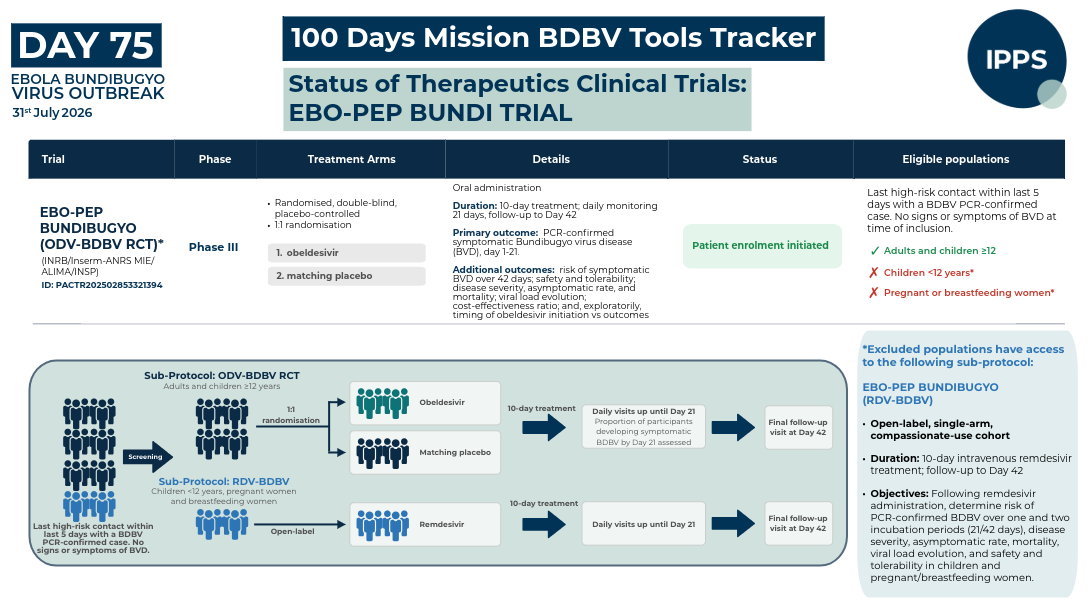
EBO-PEP is a pan-filovirus platform trial evaluating post-exposure prophylaxis (PEP) strategies for people at high risk of developing filovirus disease following a known exposure. In previous Ebola outbreaks caused by Zaire ebolavirus, the established PEP strategy for high-risk contacts has been vaccination with rVSV-ZEBOV (Ervebo), but this approach has a critical limitation: the vaccine does not generate antibodies for approximately the first ten days after administration, leaving contacts who are already in the incubation period unprotected.
During the 2018-2020 Ebola outbreak in North Kivu and Ituri – caused by Zaire ebolavirus and the second largest on record – a Monitored Emergency Use of Unregistered and Experimental Interventions (MEURI) pilot study administered monoclonal antibodies to 23 vaccine-naïve high-risk contacts one day after exposure (21 MAb114; 2 Regeneron); none developed disease. The result was encouraging but the study was observational, too small to be conclusive, and difficult to draw firm conclusions from. INRB and ANRS Emerging Infectious Diseases (ANRS MIE), an autonomous agency of Inserm, subsequently built the EBO-PEP consortium specifically to evaluate PEP rigorously, with a randomised trial protocol prepared in advance of the next outreach. The platform has been in preparation since 2024 and is designed to operate across a network of countries in sub-Saharan Africa. Like PARTNERS, it is structured around a master protocol – covering all filoviruses, all levels of exposure, and multiple outbreak settings – with sub-protocols that introduce intervention and population-specific parameters, meaning that when the BDBV outbreak was declared, a BDBV-specific obeldesivir sub-protocol could be activated without building the trial infrastructure from scratch.
Trial Design
EBO-PEP is a Phase III randomised placebo controlled platform trial, co-sponsored by INRB and ANRS MIE, and coordinated by Alliance for International Medical Action (ALIMA). Africa CDC is an institutional partner, contributing scientific coordination and direct technical support to field teams. The current BDBV sub-protocol – EBO-PEP ODV-BDBV – is a double-blind, placebo-controlled superiority trial evaluating obeldesivir against placebo in a 1:1 randomisation. Eligible participants must have had a high-risk contact within the preceding five days and must not be showing any signs or symptoms of disease; high-risk contact is defined as direct contact with a PCR-confirmed case showing wet symptoms or with their body fluids, direct contact with the dead body of a confirmed or probable case, or a needlestick with a contaminated syringe. Obeldesivir is administered orally twice daily for ten days under directly observed therapy. The trial aims to enrol a total of nearly 1,000 participants. The primary outcome is the proportion of participants developing symptomatic BVD by Day 21, with safety monitored throughout including liver and renal function at scheduled visits. An interim analysis is planned at mid-recruitment to assess early efficacy and futility and to reassess the required sample size if needed. A final visit takes place at Day 42.
Obeldesivir and remdesivir share the same active metabolite – the nucleoside triphosphate GS-443902, which inhibits viral RNA polymerase across a broad range of filoviruses. Obeldesivir’s oral administration, lack of cold-chain requirement, and absence of the need for IV infrastructure make it well-suited to a PEP strategy that must reach people rapidly, often far from treatment centres. For treatment of confirmed cases, however, IV remdesivir has been recommended: patients with active filovirus disease frequently develop severe gut dysfunction that compromises oral absorption, require higher immediate drug concentrations than oral dosing delivers, and may be too ill to swallow medication.
The obeldesivir sub-protocol does not include children under 12, pregnant women, or breastfeeding women: no paediatric formulation currently exists, there is insufficient evidence to guide safe dose adjustment of adult tablets in children (although the drug has a wide therapeutic window), and unpublished preclinical embryotoxicity data in rabbits from Gilead currently precludes use in pregnant and breastfeeding women. Gilead is working to develop a paediatric formulation in ongoing discussions with WHO and PENTA, and pharmacokinetic studies to support dose adjustment are underway. In the interim, a parallel sub-protocol – EBO-PEP RDV-BDBV – offers IV remdesivir to these groups under a compassionate use framework, administered once daily for ten days, drawing on a more developed safety evidence base for remdesivir in children and pregnant women than currently exists for obeldesivir, including data from the Ebola context.
While the remdesivir sub-protocol ensures that these groups are not left entirely without a PEP option, IV administration in community settings presents significant operational challenges – requiring trained staff, equipment, and infrastructure that are rarely available outside treatment centres. Generating the evidence needed to extend obeldesivir’s use to children, pregnant women, and breastfeeding women therefore remains an urgent priority, both for this outbreak and for future filovirus responses.
Current progress
EBO-PEP opened recruitment on 14 July 2026 in Ituri province, DRC, made possible by preparatory work carried out across 2025. The first PEP centres have been established adjacent to ALIMA’s Ebola treatment centres in Bunia and Rwampara. The trial has received initial funding from the Global Health EDCTP3 partnership, Africa CDC, and contributions from DRC and South Africa, but additional financing is required to complete the study.
Therapeutics Access
Generating evidence of efficacy is a necessary but insufficient condition for getting effective treatments to the people who need them. The history of Ebola therapeutics offers a cautionary precedent: Ebanga, a monoclonal antibody proven safe and effective in a high-quality randomised controlled trial conducted in DRC and subsequently licensed by the US FDA for Ebola Zaire, is not licensed by regulatory authorities in African countries and remains unavailable at scale to the communities that bore the burden of the outbreak that generated the evidence for its approval. Avoiding a similar outcome for the candidates now in trial for BDBV requires deliberate action before trial results are available, not after.
Achieving post-trial access is a priority both for the current outbreak and more broadly – effective therapies must be affordable and available to affected populations. Funders, manufacturers, government bodies, and clinical teams are engaged in ongoing discussions on post-trial access for BDBV therapeutics in development, spanning both treatment and PEP candidates. A key consideration emerging from these discussions is manufacturing scale-up: given the relatively early development status of therapeutic candidates, it is likely that much of this will need to be done at risk – committing to production ahead of efficacy data – to avoid delays in getting treatments to patients if trials are successful. Licensing arrangements will also need to ensure that products can be used in the current outbreak and in future filovirus responses, at prices appropriate for the settings where they are needed.
Coordinating this work is proving difficult. Responsibility for therapeutics procurement and at-risk manufacturing financing is fragmented across the ecosystem, without a single organisation clearly positioned to hold this remit end-to-end in the way CEPI and Gavi do for vaccines – and even convening the relevant funders, manufacturers, and government stakeholders around a shared plan has been a challenge in itself. In the absence of the dedicated financing and coordination infrastructure that exists for vaccines, Unitaid is playing a critical bridging role. On 10 July 2026, Unitaid announced an investment package of up to US$3.4 million to prepare for rapid access to promising new diagnostics and therapeutics should they prove safe and effective. Building on existing partnerships with Africa CDC, WHO, CHAI, PATH, and The Aurum Institute – enabling activities to begin immediately rather than waiting for new mechanisms to be established – the package supports validation of new diagnostic tools, market intelligence and forecasting for promising diagnostics and medicines, development of access roadmaps to accelerate introduction of products rapidly and equitably, and identification of innovative technologies to improve patient care in affected areas. The package has flexibility to expand through further investment should complementary funding become available. These efforts are essential – but they are being built in real time, against the clock of an active and growing outbreak. Access will be needed the day after a positive efficacy result is announced, and therapeutic trials read out on considerably shorter timelines than vaccine trials – lending significant urgency to these coordination efforts.
This outbreak illustrates a broader gap: most therapeutics against pathogens with pandemic potential (including Ebolavirus) remain pre-clinical, as illustrated by analysis by the Intrepid Alliance. To fill this critical gap, it remains important to ensure end-to-end coordination of R&D, from early-stage research through to manufacturing, to achieve the 100 Days Mission goal of two phase 2-ready therapeutic candidates per priority viral family.
This gap in the therapeutics pipeline underscores the need for greater investment in, and coordination of, end-to-end therapeutics development in peacetime, so that products are available when an outbreak occurs. A recent Africa CDC and WHO paper further highlights this gap, reiterates the key role candidate therapeutics play in reducing morbidity and mortality, and the need to identify mechanisms which address ongoing tensions between public health objectives and commercial incentives.
To this end, a range of partners – including IPPS, Unitaid, DNDi, READDI and the Intrepid Alliance – worked together on a therapeutics roadmap that recommended establishing the Therapeutics Development Coalition (TxDC). These partners, alongside others, have since been working to bring the TxDC into being. It aims to unite public and private sector organisations to identify and close gaps in therapeutics development for pathogens with pandemic potential, and draws on the expertise of a Portfolio Committee of public and private drug development experts. The initiative has gained significant traction, including from HERA as part of its Global Health Resilience Initiative strategy.
All therapeutic modalities are included within the scope of the TxDC (with the recognition that small molecule broad-spectrum antivirals tend to enable faster, more cost-effective development of antivirals). While the Coalition takes an end-to-end focus, it will initially concentrate on early-stage R&D, given the current gap in the pipeline and limited availability of therapeutics. TxDC aims to align with, rather than duplicate, ongoing efforts such as the WHO R&D Blueprint CORCs and the Global Coalition for Local and Regional Production, Innovation and Equitable Access, working across the ecosystem to support efforts to ensure therapeutics are available to respond to future outbreaks.
Vaccines
Effective, rapidly and equitably available vaccines are essential to help curtail the outbreak and save lives – preventing disease, protecting health workers facing repeated exposure, and removing susceptible people from the chain of transmission through ring vaccination.
At Day 75, the BDBV vaccine response has moved rapidly, with a funded portfolio of candidates advancing across multiple platforms and the first Phase I trial of a BDBV-specific vaccine now underway. This speed reflects years of prior investment in platform technologies, manufacturing partnerships, and filovirus-specific research, rather than anything unique to this outbreak. It does not, however, mean a new vaccine will be authorisable within the 100-day window: the distance between a Phase I trial and a product available for use in the field remains significant, and this gap is best understood as a real-world test of existing preparedness rather than a shortfall of the response. The pace and ambition of the response since outbreak declaration is consequential – both for the trajectory of this outbreak and for and for future preparedness against filovirus threats.
Candidate selection and funding
Rapid response platform vaccines
On 1 June 2026, CEPI announced it would fast-track BDBV-specific candidates – ChAdOx1-BDBV (Oxford/Serum Institute of India), and an mRNA-LNP candidate (Moderna) – selected following a global review and consultation with WHO, Africa CDC, Gavi, and affected countries. The selection reflects CEPI’s strategy of investing across multiple platforms to increase the chances of delivering a safe and effective vaccine at speed. For the Oxford/Serum Institute of India (SII) candidate, CEPI is supporting preclinical testing, Master Virus Seed stock creation, and manufacturing of clinical-grade doses at SII (detailed further below). For Moderna’s mRNA-LNP candidate, CEPI is supporting preclinical testing, Phase 1 trials, and simultaneous at-risk manufacturing to enable immediate progression to Phase 2/3 if Phase 1 data supports it.
rVSV platform vaccines
On 1 June, CEPI also announced funding for BDBV-specific candidate rVSV-BDBV-GP (IAVI), supporting Master Virus Seed stock generation and testing using material originally developed at the University of Texas Medical Branch. On 8 June, CEPI awarded further funding to Public Health Vaccines to support Master Viral Seed stock generation for an rVSV-vectored BDBV candidate based on NIAID research – one of two rVSV-vectored candidates BARDA has separately funded Public Health Vaccines to develop, the other in collaboration with the Public Health Agency of Canada. On 12 June, the US Department of State committed $50 million to CEPI to accelerate BDBV medical countermeasures, with CEPI’s stated goal to advance at least two candidates through to emergency authorisation. On 30 July, CEPI announced a collaboration with Hilleman Laboratories (a Singapore-based MSD/Wellcome joint venture) to manufacture rVSV-platform BDBV vaccine doses for clinical trials. Hilleman will initially take forward the Master Virus Seed generated by IAVI (rVSV-BDBV-GP), with up to US$8.5 million in CEPI funding, and the partners have flagged potential future extension to other CEPI-funded rVSV candidates. MSD is providing technical expertise on the rVSV platform under a July Statement of Intent.
Expanding the candidate base and assessing existing filovirus vaccines
Alongside candidate funding, CEPI has run two complementary calls to shape the broader evidence base: one to advance additional early-stage BDBV candidates toward Phase 1 evaluation, and one to generate the evidence needed to inform vaccine R&D decision-making – covering epidemiological modelling and advanced analytics to support epidemic intelligence, forecasting, scenario planning, and clinical trial feasibility, as well as Immunological and clinical assessment of potential cross-reactive antibodies induced by licensed or investigational vaccines against Zaïre and Sudan (SUDV) ebolavirus in humans. Both closed in June, with selections underway. BARDA’s BundiVx Programme, which sought VSV-platform BDBV candidates for GMP manufacturing, nonclinical studies, and Phase 1 evaluation, also closed in June, with outcomes awaited.
On cross-protection from licensed Ebola vaccines specifically, WHO’s Technical Advisory Group previously found the evidence insufficient to resolve the question. Since then, a peer-reviewed NEJM correspondence has reported cross-reactive BDBV antibodies in recipients of both licensed regimens, at much lower levels than against EBOV itself and of unknown protective value; a Lancet Infectious Diseases correspondence has argued for reconsidering Ervebo’s use in high-risk populations pending prospective evaluation; WHO’s guidance is unchanged. Further serological work assessing this cross-reactivity is planned by CEPI. There are currently no public plans for clinical trials.
Manufacturing readiness
Manufacturing readiness, not just scientific readiness, determines whether a trial can start – and this outbreak illustrates this point in both directions.
Manufacturing readiness encompasses pre-established manufacturing partnerships, validated platform processes, quality systems, supply chain resilience, regulatory preparedness, and the availability of manufacturing capacity that can be activated without delaying development. Together, these elements determine whether vaccine candidates can move rapidly from sequence selection to clinical evaluation and, if successful, to large-scale deployment.
A vaccine platform is a vaccine-making technology built around a reusable backbone, which can be adapted to a new pathogen by substituting the genetic or protein sequence it delivers, without redesigning the underlying manufacturing process. SII was able to draw on exactly this kind of reusability: because ChAdOx1-BDBV leverages the existing ChAdOx platform, alongside pre-existing partnership and institutional arrangements between SII, Oxford, and CEPI, SII was able to manufacture doses at risk within two weeks (620,000 stockpiled / 4,000 investigational) – enabling BD-EBOV-01 to launch as the world’s first Phase Ia trial of a BDBV-specific vaccine (see trial details below). The same platform’s track record bears this out: SII produced 400,000 doses of a Rift Valley Fever vaccine just 16 days after receiving the essential ingredients during the recent RVF outbreak.
Moderna’s candidate will be next into trial; its platform also has high manufacturing readiness, and CEPI’s funding explicitly supports parallel at-risk manufacturing alongside preclinical and Phase 1 work, so that doses can support an immediate start to Phase 2/3 trials if Phase 1 data are supportive. The rVSV candidates illustrate the same dependency in reverse: without pre-existing platform and manufacturing infrastructure, trials cannot begin on the same timeline, however promising the candidates may be – though CEPI’s manufacturing partnership with Hilleman Laboratories, drawing on MSD’s rVSV expertise, marks a concrete step toward closing this gap for rVSV-BDBV-GP.
This outbreak has shown what two platforms with this level of manufacturing readiness can achieve – but readiness of this kind cannot be assumed for the next threat. It also illustrates the importance of maintaining multiple manufacturing-ready platform technologies with complementary characteristics. Viral vector, mRNA and other platform technologies each offer distinct advantages in development speed, manufacturing scalability, cold-chain requirements and product characteristics. Investing across multiple manufacturing-ready platforms increases.
Manufacturing readiness needs to exist on additional platforms with diverse characteristics in advance of the next outbreak, to increase resilience against scientific, technical and manufacturing risks while providing flexibility to respond to different outbreak scenarios – giving the next response more options from day one.
Clinical readiness
Clinical trials have launched quickly – the first trial, BD-EBOV-01, launched, with the first dose on 24th July, just 10 weeks from the PHEIC declaration (the same ChAdOx platform took 12 weeks from PHEIC to first dose during the COVID pandemic) (see trial details below). A second trial, of Moderna’s mRNA candidate, is expected to start in August.
While these first Phase 1 trials are both being held in high-income countries, the need to conduct Phase 1 trials in Africa is imperative. More than 45 clinical trial sites with Phase 1 experience, representing 17 African countries, responded to a CEPI RFI. Substantial capacity, particularly in Kenya, South Africa and Uganda exists, with long-standing clinical development partnerships in place. Sites provided information including prior Phase I and outbreak-pathogen experience, biosafety capability, ethics and regulatory timelines, quality-system maturity, and Material Transfer Agreement procedures. Notable strengths from 12 sites across 12 countries were highlighted. This reflects self-reported, unverified information rather than a ranking or endorsement of sites; developers are expected to conduct their own feasibility assessments and site visits before selection. The underlying data is provided in a searchable database, intended to support developers in identifying candidate sites according to their own criteria, alongside factors the RFI does not capture, such as cost, contracts, existing sponsor relationships, and current site availability.
BD-EBOV-01 trial
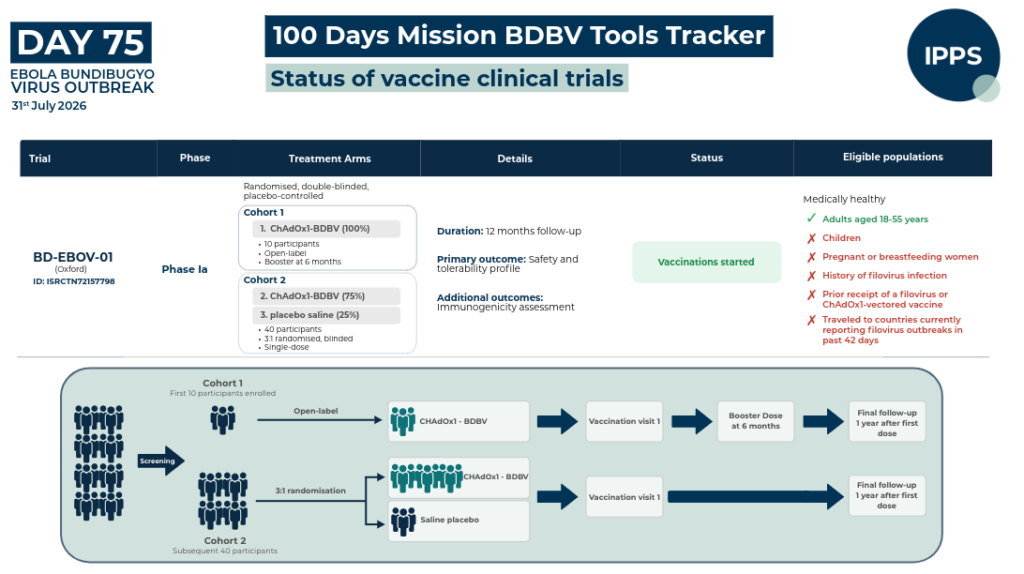
On 13 July 2026 the University of Oxford’s Oxford Vaccine Group launched BD-Ebov-01, the world’s first Phase I clinical trial of a vaccine targeting BDBV, representing the first human evaluation of a BDBV-specific vaccine candidate. The candidate, ChAdOx1-BDBV, was developed by scientists at the Oxford Vaccine Group and Pandemic Sciences Institute, building on more than thirty years of vaccine development at the group and on filovirus-specific work dating back to the 2013-2016 Ebola outbreak, since when the Oxford team has continued developing ChAdOx1-based candidates against Sudan ebolavirus, Marburg virus, and other outbreak pathogens. The ChAdOx1 platform has generated encouraging preclinical data against multiple filoviruses including Zaire ebolavirus, Sudan virus, and Marburg virus, and has demonstrated favourable safety and immunogenicity in early clinical studies, supporting its evaluation for BDBV vaccine development. The trial is funded by CEPI as part of a US$8.6 million programme supporting preclinical testing, Master Virus Seed stock creation, and manufacturing of clinical-grade doses at the Serum Institute of India under CEPI’s pre-existing partnership agreement with SII.
Trial Design
BD-Ebov-01 is a Phase Ia randomised double-blind placebo-controlled trial evaluating ChAdOx1-BDBV in 50 healthy adults aged 18-55 in Oxford. Participants must be in good health with no history of filovirus infection or prior receipt of a filovirus or ChAdOx1-vectored vaccine, and must not have travelled to countries currently reporting filovirus outbreaks in the 42 days prior to enrolment. The trial proceeds in two cohorts: the first ten participants are enrolled in an open-label group and all receive a single dose of the vaccine, allowing early safety data to be collected and reviewed before the blinded phase begins; the subsequent forty participants are randomised 3:1 to receive either the vaccine or a saline placebo. Participants in the first cohort will also receive a booster dose at six months, generating exploratory data on whether a prime-boost regimen enhances the immune response. The primary outcome is safety and tolerability: the trial tracks solicited local and systemic reactogenicity in the seven days following vaccination, unsolicited adverse events up to 28 days, laboratory safety measures throughout the study period, and serious adverse events and adverse events of special interest until the end of the study. The secondary outcome is immunogenicity – the antibody and cellular immune responses generated by a single dose. The study is expected to run to December 2027.
Current progress
The first participants were enrolled on 20 July 2026, with vaccinations now underway. Subject to regulatory approval, preparations are underway for further clinical studies in Uganda with partners including the MRC/Uganda Virus Research Institute and the London School of Hygiene and Tropical Medicine Uganda Research Unit. If Phase I data are supportive, CEPI anticipates working with the University of Oxford and SII to support the late-stage trials needed for emergency use authorisation or full licensure. CEPI, SII, and the University of Oxford have all committed publicly to enabling rapid and affordable supply of Bundibugyo vaccines to affected countries and to the populations that need them most.
Vaccines Access
As clinical development of vaccines against Bundibugyo Virus Disease (BVD) progresses rapidly, efforts are underway to prepare for post-trial access.
Vaccine R&D and manufacturing efforts, even with doses available, may not by themselves stop outbreaks or ensure vaccines are used – in Bundibugyo, hesitancy and mistrust are critical barriers. Vaccine outbreak response should be country-informed and country-led, with affected countries, communities and people at its core. To identify and prioritise access needs and map the pathway to equitable access, vaccine partners are coming together in support of the c-IMST to develop a vaccine access roadmap; no organisation can achieve equitable access alone. This work aims to identify critical access needs and enable transparency across stakeholders, serve as a call-to-action for governments and industry on short- and long-term priorities, link upstream R&D with downstream access work, and support smooth transitions between partners in the ecosystem. This roadmap is still in development.
In the interim, the following priorities have been identified. These are draft and non-exhaustive and need further discussions:
- Sustain clinical trial momentum. Getting Phase 1 studies underway and finalising the Phase 3 platform trial protocol remain key priorities. Funding for Phase 3 trials has not yet been committed, and efforts to raise investment are ongoing.
- Understand country-level acceptability for vaccine candidates. Initial recommendations from the WHO TAG-CVP (Technical Advisory Group on Candidate Vaccine Prioritization) regarding candidate vaccines are available. Funders will assess which candidates to support for Phase 3 studies and Advance Purchase Commitments. All these efforts must include country-level participation to ensure that local considerations and product suitability for deployment under outbreak conditions in the DRC and Uganda are adequately addressed.
- Integrate RCCE and social and behavioural science into trials and beyond. CEPI-funded trials are expected to incorporate social and behavioural science principles and community engagement to build trust and inform trial design, and WHO is also conducting social-behavioural research and RCCE activities prior to and during trials, as well as during the later roll out of MCM interventions. Sustained systemic engagement to build long-term vaccine acceptability will remain critical.
- Resolve indemnification and liability gaps. Manufacturers supplying investigational vaccines for expanded access protocols will require product liability indemnity. No mechanism currently exists, and one is needed urgently for post-trial access. This should also include the PIs, sponsors and cover the medical care and indemnification of AEs.
- Integrate special access approaches for displaced and refugee populations. Some communities will need targeted access approaches, including independent, community-led channels – such as those run by UNHCR and humanitarian partners – rather than relying solely on conventional delivery mechanisms.
- Ensure country readiness to have regulatory pathways to approve, receive and deliver vaccine doses, including timely NITAG policy recommendations, training of healthcare populations, storage of vaccines, and access to remote populations.
The current focus of this work is resolving immediate post-trial access needs for the Bundibugyo outbreak. Over the medium to long term, its scope is expected to expand to preparedness for future outbreaks and the transition to multivalent or broadly protective filovirus vaccines.
Calls for Expression of Interest and Proposals
Diagnostics
WHO Emergency Use Listing (EUL) for nucleic acid detection tests: Manufacturers should submit expressions of interest through the EUL questionnaire. Formal submission instructions and requirements for manufacturers seeking EUL approval for in vitro diagnostics detecting Bundibugyo virus nucleic acids. [related to current response]
The Gates Foundation issued an RFP on 6 July for decentralised pan-Orthoebolavirus diagnostics across five priority areas: biomarkers, specimen validation, field-deployable tests, surveillance systems, and quality assurance (Deadline 31 July). [related to current response]
The RIGHT Foundation has opened a request for proposals under its 2026 Product Development Award Targeted Call, supporting validation of existing diagnostic products with proof-of-concept or preliminary performance data for Ebola, including Bundibugyo virus, disease diagnostics in World Bank-defined low- and middle-income countries (LMICs). (Deadline 18 August). [related to current response]
Therapeutics
Development of monoclonal antibody therapeutics for prevention and treatment of filoviral and related emerging viral infections (Deadline 13 April 2027). [early stage]
Vaccines
EU investigational filovirus vaccine reserve tender: the European Commission is seeking to establish and maintain an investigational reserve of candidate vaccines against Ebola Sudan, Bundibugyo, and/or Marburg viruses for rapid deployment in outbreak-associated clinical trials. (Deadline 2 September 2026). [related to current response]
Acknowledgements
The vaccines deep dive in this update draws extensively on data and insights provided by CEPI. We are also grateful to Africa CDC, Airfinity, ANRS MIE, Cepheid, FIND, Gilead, HUG, IFPMA, i-MCM-Net Secretariat, Institut Mérieux, Intrepid Alliance, MSD, NDM Oxford, Pandemic Pact Programme, PANTHER Health, PATH, Roche, Unitaid, Wellcome, and WHO for providing data, verification, and critical feedback to this tracker.
If you have additional updates or information you would like to see reflected in future iterations, please contact us at info@ippsecretariat.org.
Disclaimer for the Ebola Bundibugyo MCM Tools Tracker
Data shown in the tracker is not exhaustive. It prioritises candidates assessed by WHO TAG, actively discussed in partner coordination meetings and working groups, recommended by Africa CDC, and currently deployed or under evaluation. Additional products and updates will be integrated as they emerge and as existing candidates progress through development and evaluation.