
100 Days Mission Ebola Clock: Day 60 (minor update)
The 100 Days Mission (100DM) clock for Bundibugyo ebolavirus started on 18 May 2026, following the World Health Organization’s declaration of the Ebola outbreak in the Democratic Republic of Congo and Uganda as a Public Health Emergency of International Concern (PHEIC). Today we are publishing the Day 60 update on diagnostics, therapeutics, and vaccine availability for Bundibugyo virus.
Leading up to Day 100 on 25 August, IPPS will provide updates every 15 days (alternating between major and minor) on the status and progress of diagnostics, therapeutics, and vaccine development for Bundibugyo virus. The major updates provide detailed deep dives into these medical countermeasures and highlight specific priority actions to support the timely availability and equitable deployment of medical countermeasures to affected and at-risk countries. As a minor update, today’s publication simply tracks factual changes to the indicators in our tracker, providing a regular checkpoint on progress toward the 100-day milestones.
These updates are intended to support the work of partners and key initiatives and are developed in consultation with implementing partners of the 100DM. We are open to feedback on the accuracy of our data, please get in touch (info@ippsecretariat.org) if you have information to share.
Previous updates:
Key developments since Day 45
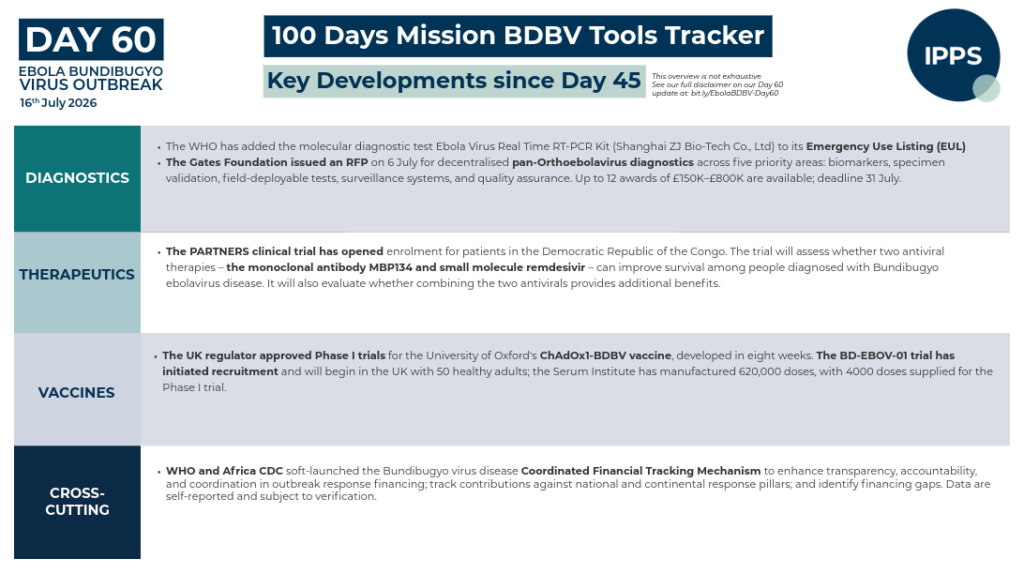
Diagnostics
- The WHO added the molecular diagnostic test Ebola Virus Real Time RT-PCR Kit (Shanghai ZJ Bio-Tech Co., Ltd) to its Emergency Use Listing (EUL).
- The Gates Foundation issued an RFP on 6 July for decentralised pan-Orthoebolavirus diagnostics across five priority areas: biomarkers, specimen validation, field-deployable tests, surveillance systems, and quality assurance. Up to 12 awards of £150K–£800K are available; deadline 31 July.
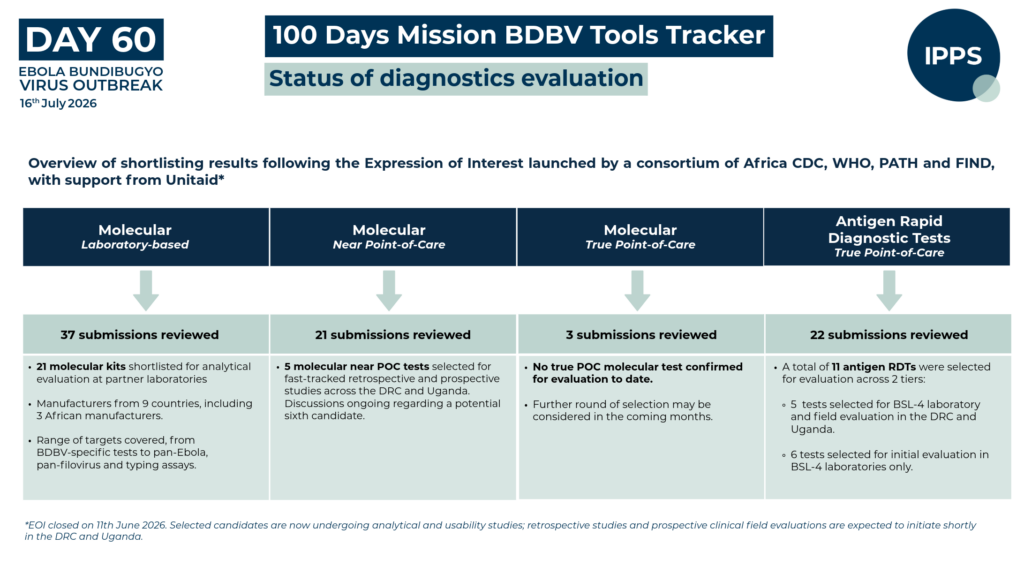
- Ongoing work to validate diagnostic candidates shortlisted through the EOI launched by Africa CDC, WHO, PATH, FIND and Unitaid is being taken forward under the name BRIDGE-Access. Shortlisted manufacturers are in the process of signing an access terms agreement developed by Unitaid and partners.
Therapeutics
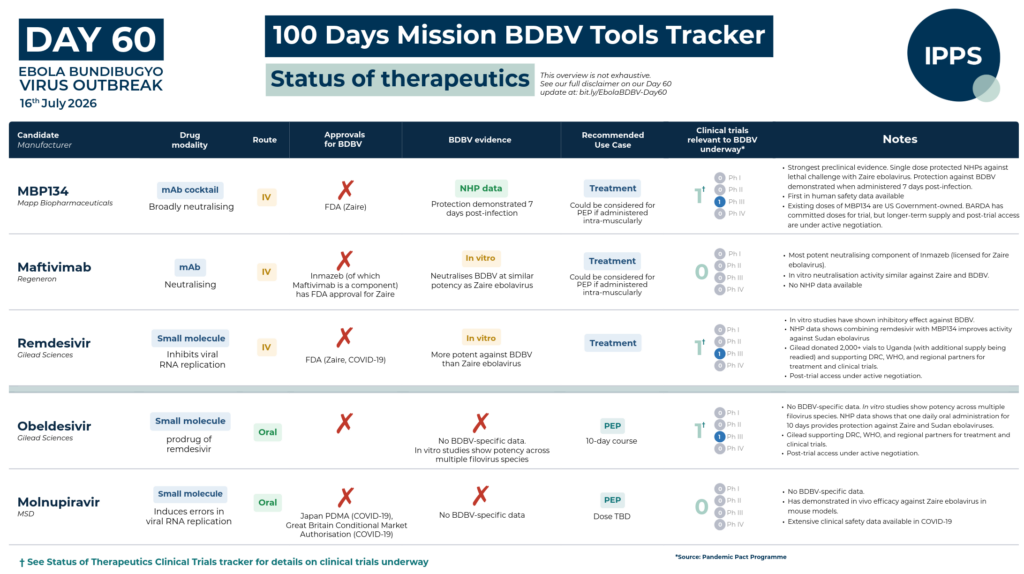
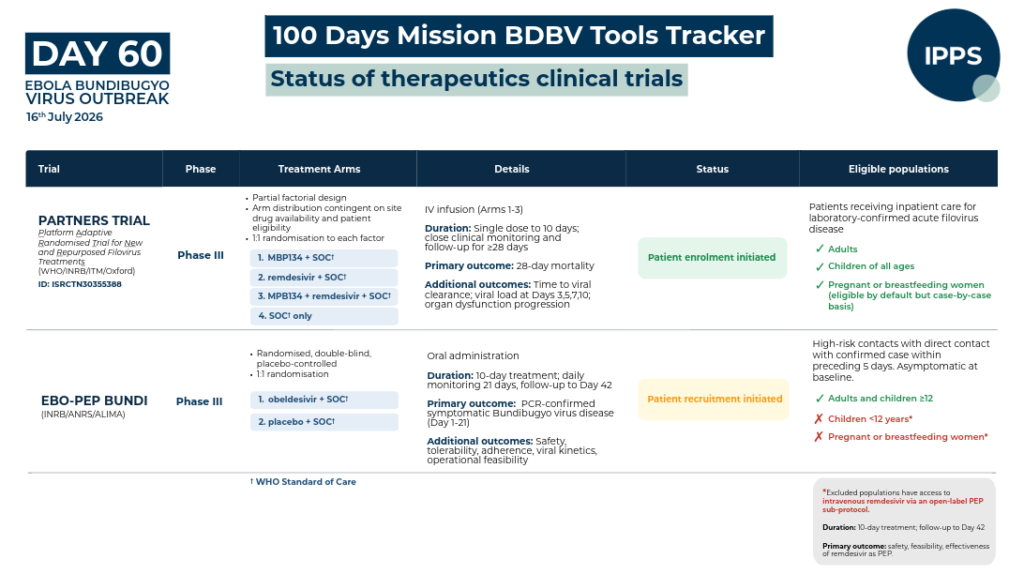
- The PARTNERS clinical trial enrolled its first patient in the Democratic Republic of the Congo on 02 July 2026, seven weeks after the outbreak was first declared. The trial will assess whether two antiviral therapies – the monoclonal antibody MBP134 and small molecule remdesivir – can improve survival among people diagnosed with Bundibugyo ebolavirus disease. It will also evaluate whether combining the two antivirals provides additional benefits.
- The EBO-PEP clinical trial has opened recruitment for high-risk contacts in the Democratic Republic of the Congo and Uganda on 14 July 2026. The trial will assess whether the antiviral obeldesivir, administered orally as a post-exposure prophylaxis strategy, can prevent the development of Bundibugyo Ebola virus disease among people with direct contact exposure. For children, pregnant and breastfeeding women who are high-risk contacts and excluded from the study, a sub-protocol exists offering 10 days of Intravenous Remdesivir under monitored compassionate use.
Vaccines
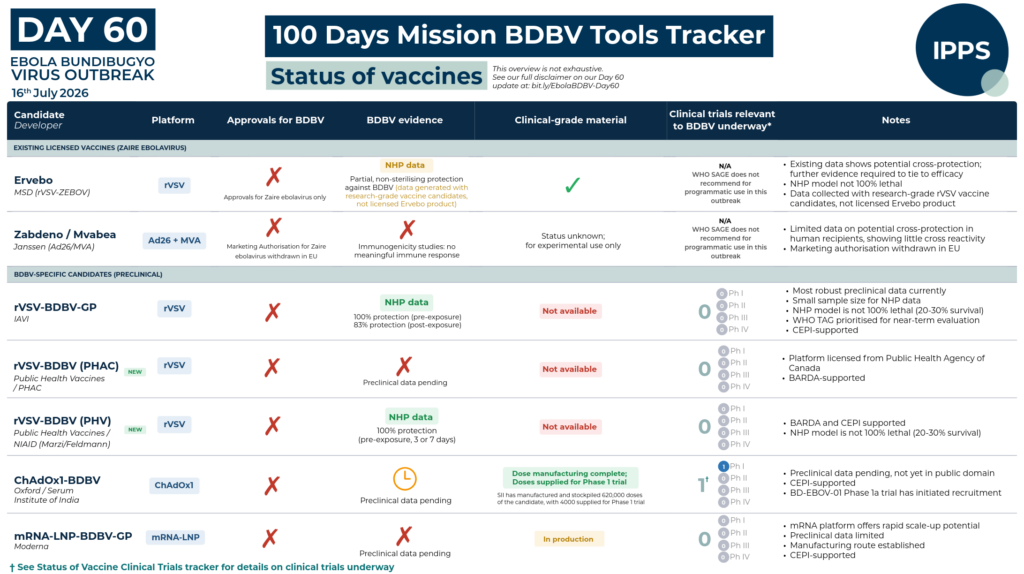
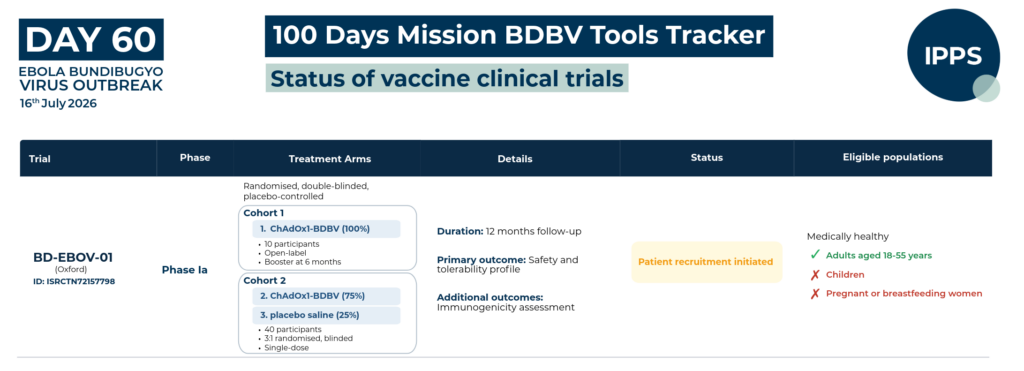
- The UK regulator approved Phase I trials for the University of Oxford’s ChAdOx1-BDBV vaccine, developed in eight weeks. The BD-EBOV-01 trial has initiated enrolment and will begin in the UK with 50 healthy adults; the Serum Institute has manufactured 620,000 doses, with 4000 doses supplied for the Phase I trial.
- WHO R&D Blueprint published WHO Target Product Profiles (TPPs) for Bundibugyo Vaccines.
Cross-cutting
- WHO and Africa CDC soft-launched the Bundibugyo virus disease Coordinated Financial Tracking Mechanism to enhance transparency, accountability, and coordination in outbreak response financing; track contributions against national and continental response pillars; and identify financing gaps. Data are self-reported and subject to verification.
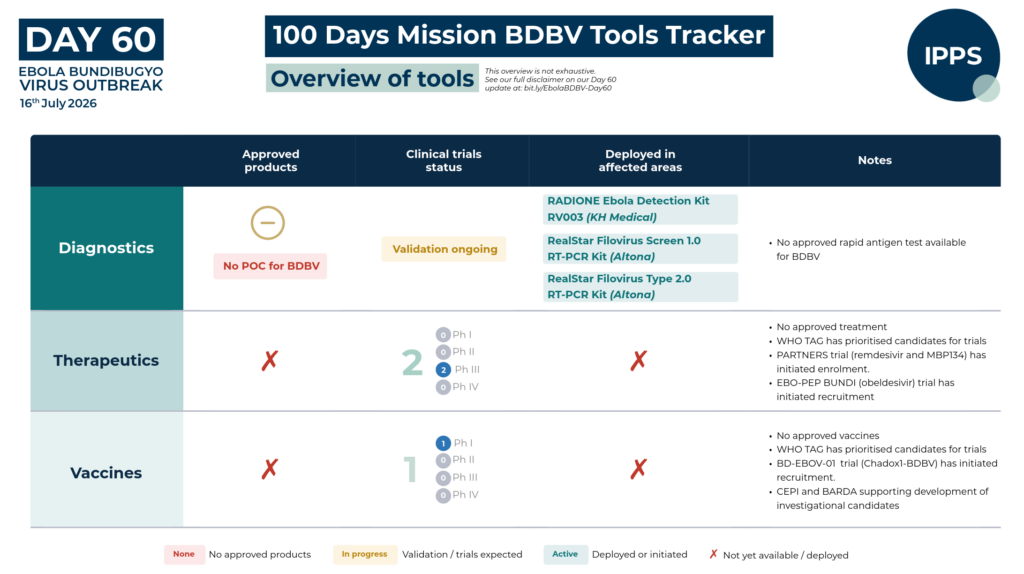
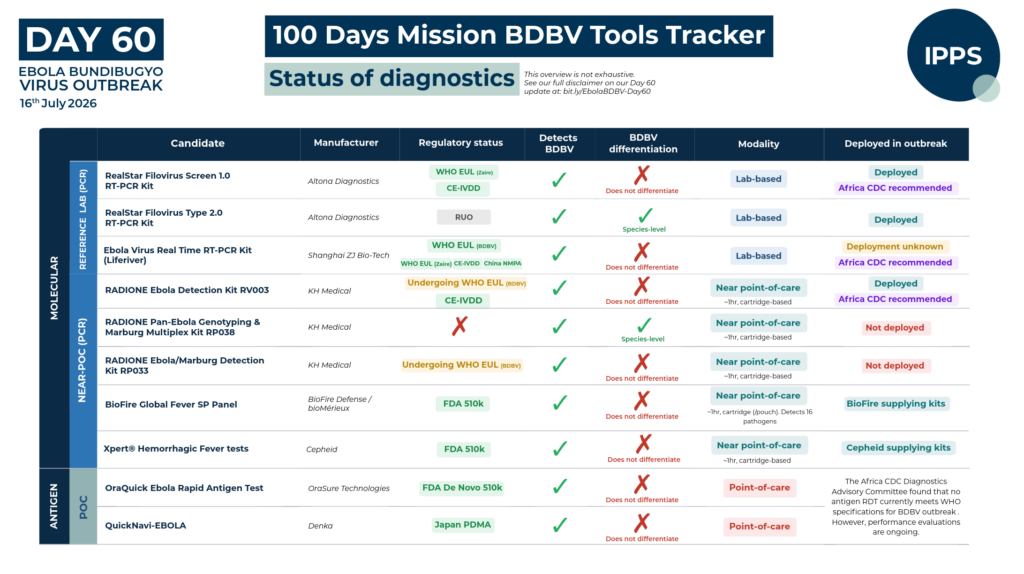
Status of DTVs
The medical countermeasures outlined in this section are not an exhaustive inventory of all products in development globally. Rather, they represent the candidates currently identified as leads for the response – those assessed by WHO TAG, actively discussed in partner coordination meeting, recommended for use by Africa CDC, and currently deployed or under evaluation. As new products emerge and existing candidates progress through development and evaluation, this landscape will continue to evolve.
Calls for Expression of Interest and Proposals
Diagnostics
WHO Emergency Use Listing (EUL) for nucleic acid detection tests: Manufacturers should submit expressions of interest through the EUL questionnaire. Formal submission instructions and requirements for manufacturers seeking EUL approval for in vitro diagnostics detecting Bundibugyo virus nucleic acids. [related to current response]
The Gates Foundation issued an RFP on 6 July for decentralised pan-Orthoebolavirus diagnostics across five priority areas: biomarkers, specimen validation, field-deployable tests, surveillance systems, and quality assurance (Deadline 31 July). [related to current response]
Therapeutics
Development of monoclonal antibody therapeutics for prevention and treatment of filoviral and related emerging viral infections (Deadline 13 April 2027). [early stage]
Vaccines
EU investigational filovirus vaccine reserve tender: the European Commission is seeking to establish and maintain an investigational reserve of candidate vaccines against Ebola Sudan, Bundibugyo, and/or Marburg viruses for rapid deployment in outbreak-associated clinical trials. (Deadline 2 September 2026). [related to current response]
Acknowledgements
We are grateful to the Pandemic Pact Programme, FIND, CEPI, PATH, IFPMA, Gilead, Cepheid, Roche, MSD, Unitaid, PANTHER Health, Intrepid Alliance, WHO, i-MCM-Net Secretariat, Wellcome, Institut Mérieux, Airfinity, IFPMA and Africa CDC for providing data, verification, and critical feedback to this tracker.
If you have additional updates or information you would like to see reflected in future iterations, please contact us at info@ippsecretariat.org.
Disclaimer for the Ebola Bundibugyo MCM Tools Tracker
Data shown in the tracker is not exhaustive. It prioritises candidates assessed by WHO TAG, actively discussed in partner coordination meetings and working groups, recommended by Africa CDC, and currently deployed or under evaluation. Additional products and updates will be integrated as they emerge and as existing candidates progress through development and evaluation.