
The 100 Days Mission clock for Bundibugyo ebolavirus starts now.
On 17 May 2026, the World Health Organization (WHO) declared the Ebola outbreak caused by Bundibugyo virus (BDBV) in the Democratic Republic of Congo (DRC) and Uganda a Public Health Emergency of International Concern (PHEIC) pursuant to Article 12 of the International Health Regulations (IHR). Africa CDC has also signalled the growing risk of regional spread and is consulting its Emergency Consultative Group on whether to declare a Public Health Emergency of Continental Security (PHECS). The African Medicines Agency (AMA) has indicated it is working with national regulatory authorities and partners to support accelerated regulatory coordination and facilitate pathways for rapid evaluation and potential emergency use of investigational medical countermeasures across affected and at-risk countries.
As of 17 May 2026, Africa CDC reported 10 laboratory-confirmed cases, 336 suspected cases, and 88 suspected deaths in Ituri Province. Unusual clusters of unexplained community deaths across Ituri and North Kivu, and at least four deaths amongst healthcare workers, suggest the true scale of the outbreak may be significantly larger than current figures indicate. Cross-border spread has already been confirmed, with two unlinked cases detected in Uganda in individuals travelling from the DRC. No definitive index case has yet been identified, further complicating efforts to map transmission.
This outbreak presents a fundamentally different challenge from previous Ebola emergencies. Bundibugyo virus is a distinct species from Zaire ebolavirus, the species involved in both previous Ebola-related PHEICs and the focus of decades of countermeasure development. There are currently no approved vaccines, therapeutics, or point-of-care diagnostics for Bundibugyo virus, exposing critical preparedness gaps for less common but equally dangerous viral threats.
As the International Pandemic Preparedness Secretariat (IPPS), our mandate is to track and drive implementation of the 100 Days Mission – ensuring that within 100 days of a declared pandemic threat, accurate rapid diagnostics, an initial therapeutic regimen, and vaccines ready for large scale deployment are available to the communities that need them. For Bundibugyo ebolavirus, the clock starts now, and the gaps are significant.
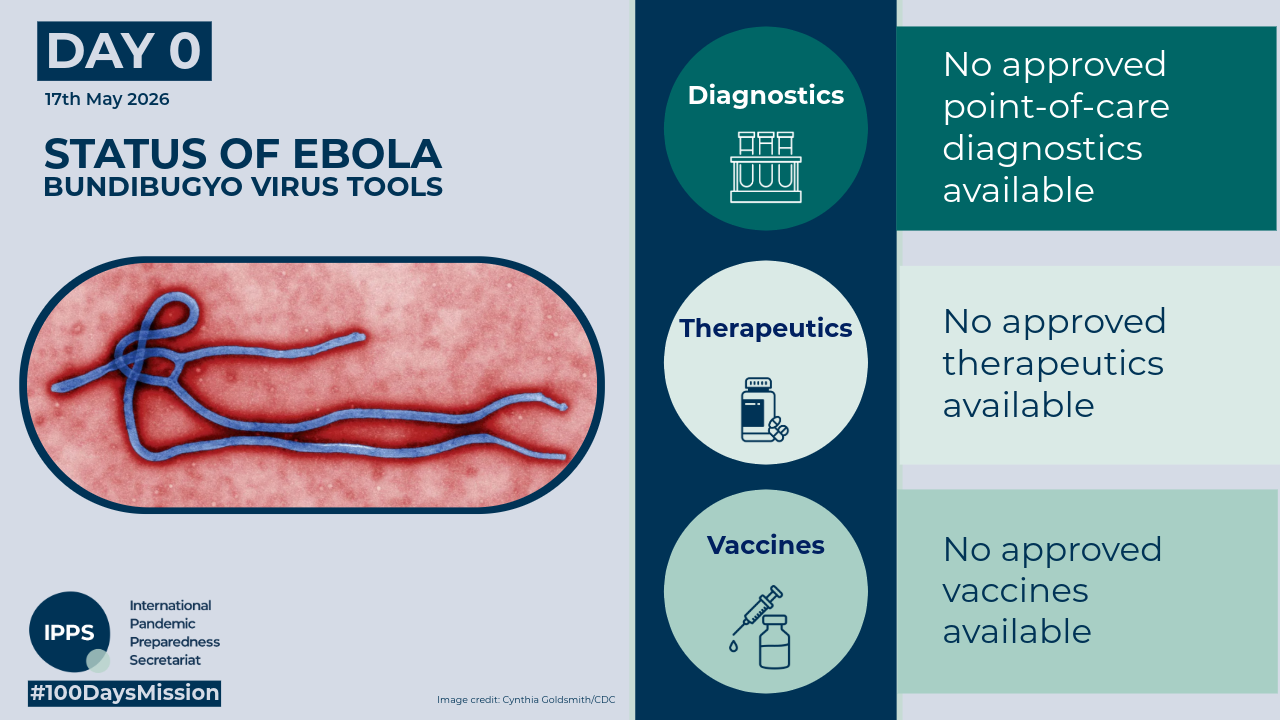
The status of diagnostics, therapeutics and vaccines for Bundibugyo ebolavirus
Diagnostics
Initial testing at the Provincial Public Health Laboratory in Bunia using the standard Ebola Xpert assay, optimised for Zaire ebolavirus, returned negative results. Confirmation required PCR and genomic sequencing at the National Biomedical Research Institute (INRB) in Kinshasa, contributing to a critical four-week detection gap. Frontline diagnostic systems across the region are built around Zaire ebolavirus, leaving them poorly equipped to detect less common species. Development and urgent deployment of rapid point-of-care diagnostics capable of identifying Bundibugyo virus must be an immediate priority, alongside decentralised laboratory capacity in affected areas.
Therapeutics:
There are currently no approved therapeutics for Bundibugyo virus disease. Licensed monoclonal antibody therapies, Inmazeb and Ebanga, are specific to Zaire ebolavirus only, underscoring the need for sustained investment in broad-spectrum therapeutics across multiple orthoebolavirus species as a standing inter-pandemic priority. Randomised controlled trials are expected to evaluate candidate treatments, including Gilead’s remdesivir, which shows greater in vitro inhibitory effect against Bundibugyo than Zaire ebolavirus, and broad-spectrum monoclonal antibodies including MBP134AF (Mapp Biopharmaceuticals), which has demonstrated protection against Bundibugyo, Zaire, and Sudan ebolavirus in non-human primate studies. Until effective countermeasures are available, supportive clinical management, including infection prevention and control (IPC), rehydration, critical care, and adequate personal protective equipment (PPE), remains central to the response.
Vaccines:
There are currently no approved vaccines for Bundibugyo virus disease. Existing WHO-recommended Ebola vaccines, Ervebo and the Zabdeno/Mvabea regimen, were developed for Zaire ebolavirus and are licensed for that species only, with Ervebo showing only low to modest cross-protection against Bundibugyo in non-human primate data. A multivalent filovirus vaccine programme targeting Bundibugyo, Zaire, Sudan, and Marburg, led by the University of Oxford with Moderna, supported by CEPI and the EU, was announced in January 2026 but remains in early preclinical development. Africa CDC and WHO have convened scientific experts to review candidate vaccines and accelerate their evaluation, including whether existing vaccines may offer any cross-protection.
IPPS calls for urgent action across three immediate priority areas over the next 100 days.
First, strengthen surveillance, diagnostic capacity, and contact tracing. Immediate efforts should focus on decentralised laboratory testing, rapid and safe sample transport, strengthened surveillance systems, cross-border information sharing, and effective contact tracing. Development and rapid deployment of point-of-care diagnostics capable of detecting Bundibugyo virus must be accelerated.
Second, rapidly initiate clinical trials for investigational therapeutics and vaccines. Randomised controlled trials evaluating candidate therapeutics and vaccines should begin as quickly as possible, alongside accelerated emergency use pathways, strengthened clinical trial infrastructure in affected regions, and equitable access arrangements for affected countries.
Third, accelerate regulatory harmonisation and operational coordination. Regulatory coordination, particularly through the African Medicines Agency, will be essential to ensure investigational products can move rapidly to affected communities. Close coordination between affected governments, WHO, Africa CDC, regulators, procurers, and implementing partners will also be critical to ensure financing and response tools can be deployed quickly and effectively.
This PHEIC declaration, coming on the eve of the 79th World Health Assembly in Geneva, is a stark reminder that pandemic preparedness must remain at the centre of global health policy. The WHO Pandemic Agreement adopted at last year’s Assembly represented a landmark commitment to equitable access to medical countermeasures – but critical negotiations remain unfinished, and this outbreak demonstrates precisely why that work must be completed with urgency. It also demonstrates that pandemic financing cannot continue to follow outbreak-driven funding cycles: sustained investment in diagnostics, therapeutics, vaccines, and preparedness infrastructure is the only way to close the gaps this outbreak has exposed.
IPPS is committed to working with 100 Days Mission partners to track progress, identify product and operational gaps, and support coordinated action throughout this response. We call on the international community to provide WHO, Africa CDC, the African Medicines Agency, and affected governments with the financing, technical support, and coordination needed to respond effectively.
The next 100 days are critical.
Dr Mona Nemer
Steering Group Chair, International Pandemic Preparedness Secretariat
Shingai Machingaidze
Science & Technology Expert Group (STEG) Co-Chair, International Pandemic Preparedness Secretariat
Dr Victor Dzau
Science & Technology Expert Group (STEG) Co-Chair, International Pandemic Preparedness Secretariat